Your email address will not be published. Required fields are marked *
Our expert reaches out shortly after receiving your request and analyzing your requirements.
If needed, we sign an NDA to protect your privacy.
We request additional information to better understand and analyze your project.
We schedule a call to discuss your project, goals. and priorities, and provide preliminary feedback.
If you're satisfied, we finalize the agreement and start your project.
Mobile and web apps are the digital hearts of hospitals and healthcare. They’re how they’re running clinical care, communicating with patients, managing their staff, streamlining their internal workflows, and more. But as digital health innovations keep booming, providers are doubling down on data security and compliance.
HIPAA compliance is a top priority for hospitals, health-tech startups, and enterprise software providers in 2025 and beyond. At Taction Software, we’re building secure, scalable, fully HIPAA-compliant software solutions for U.S.-based hospitals and digital health organizations. In this guide, we highlight the most important features your app needs to include in 2025—and how to build it correctly the first time.
In 2025, HIPAA is still the main authority on patient data security in the United States. OCR and HHS have been stricter with enforcements and handing out penalties, even for minor discrepancies or poor app architecture.
If your app stores, transmits, or interacts with PHI in any way, you have no choice but to be compliant.
If your app fits any of these user types or use cases, you need HIPAA compliance:
And yes, even if you’re only storing PHI temporarily, or using third-party platforms—you’re still responsible for compliance.
HIPAA compliance is built on three kinds of safeguards:
HIPAA is more than security. A HIPAA-compliant app is engineered for accountability, traceability and privacy protection. Without all the layers, the best security solution can turn your safest app into a time bomb.
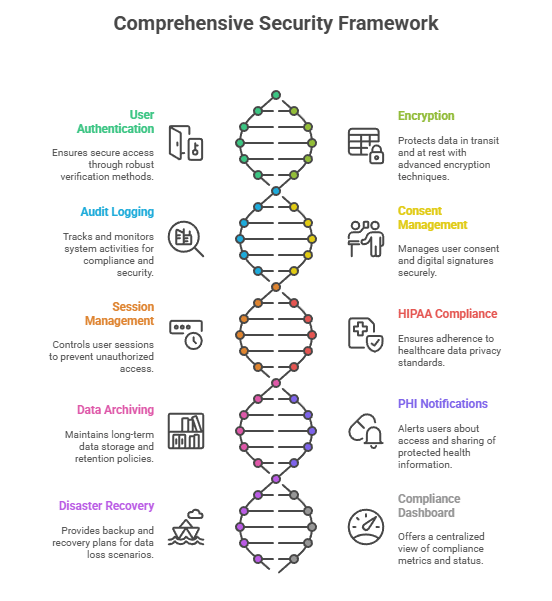
These are the non-negotiable features your app must include in 2025 to meet HIPAA standards:
Implement multi-factor authentication (MFA) and define user roles (doctors, nurses, admin staff, patients). Each user should only access what’s relevant to their job function.
All data transmission must be encrypted using TLS 1.3 or higher, while stored data should use AES-256 encryption. We ensure encryption is handled both on the app side and backend infrastructure.
Every access, edit, or export of PHI must be logged and time-stamped. Your admin panel should allow real-time alerts for unauthorized attempts or suspicious access behavior.
Track and store patient consent digitally for treatments, data sharing, or telehealth interactions. Our apps offer audit-ready, legally binding e-signature workflows.
Idle sessions should automatically expire to prevent unauthorized PHI access. This is especially important for shared workstations and tablets used in hospital settings.
In-app chat and video consultations must be encrypted and isolated from third-party tools unless properly covered by Business Associate Agreements (BAAs).
Apps should align with federal and state-specific medical record retention laws. This includes scheduled deletions, archival processes, and access expiration for outdated records.
Notify both users and admins when PHI is viewed, edited, or shared externally. Taction’s built-in compliance alert system enhances transparency and trust.
Ensure continuity during cyberattacks or server failures. Our apps offer geo-redundant backups, instant failover systems, and hourly recovery points.
Equip your app with a dashboard for compliance managers to monitor risks, access logs, policy violations, and expired consents—all in one place.
Connecting to large platforms such as Epic, Cerner, Salesforce, or a payment gateway can expose you to risk if not done securely.
At Taction, we:
We have over 20 years of experience, and our proven approach to every app is battle-tested:
Also Read: How to Anonymize PHI Before Sending to ChatGPT
MVP timeline: 6–10 weeks
Full-feature product: 3–6 months
Timelines vary based on features, integrations, platforms (iOS, Android, Web), and custom compliance requirements.
2025 price benchmarks (U.S. standards):
Startups / MVPs: $40,000 – $80,000
Mid-to-Large Hospital Systems: $120,000 – $300,000+
Cost drivers include:
Custom feature development
Number of integrations (EHR, billing, CRM)
Hosting (AWS, Azure, on-premise)
Security testing and HIPAA audits
HIPAA is no longer just a regulation, it’s a competitive edge. A compliant app is not just protective of your hospital, it makes your hospital stronger.
We at Taction Software don’t just develop apps, we provide completely compliant, scalable, and secure apps that not only meet every federal regulation but help meet your mission to better people’s lives.
Misconfigured APIs, unsecured data storage, and poor access controls are the leading causes of HIPAA violations in mobile applications.
Yes. With FHIR-based APIs and a proper BAA in place, we build Epic-integrated apps that meet full compliance standards.
Absolutely. All telehealth sessions must use encrypted transmission protocols and cannot store unprotected communication data.
No. You must use HIPAA-eligible services and configure them properly. A signed BAA with your cloud provider is also essential.
Yes. Any vendor or integration that handles PHI—analytics, messaging, payment processors—must sign a BAA to ensure compliance.