Your email address will not be published. Required fields are marked *
Our expert reaches out shortly after receiving your request and analyzing your requirements.
If needed, we sign an NDA to protect your privacy.
We request additional information to better understand and analyze your project.
We schedule a call to discuss your project, goals. and priorities, and provide preliminary feedback.
If you're satisfied, we finalize the agreement and start your project.
In today’s fast-moving digital world, businesses can no longer afford year-long software development cycles. Users expect quick, seamless solutions, while competitors are launching products faster than ever. This is where rapid prototyping in software development changes the game. By turning ideas into working models quickly, companies gain early feedback, reduce risks, and shorten the path from concept to market.
At its core, rapid prototyping software is about creating functional mockups and iterating on them until the final product meets both business goals and user needs. Unlike traditional methods, it allows teams to experiment, validate, and refine without wasting months on rigid planning.
With more than 20 years of expertise in healthcare IT, Taction Software has helped organizations—from startups building their first MVP to hospitals requiring HIPAA-compliant apps—leverage rapid prototyping to innovate faster and smarter.
In this guide, we’ll walk you through everything you need to know: the techniques of software prototyping, how the RAD methodology compares to traditional models, the best prototyping tools for developers, and the real business impact of bringing prototypes to market quickly.
Rapid prototyping in software development is the practice of quickly creating interactive models of an application to test functionality, design, and user experience before committing to full-scale development. Unlike generic software prototyping, which may involve static wireframes or basic visuals, rapid prototyping emphasizes speed and iteration—delivering functional mockups that stakeholders and end-users can interact with.
This approach is closely tied to the Rapid Application Development (RAD) methodology, which prioritizes adaptability over rigid planning. Instead of spending months defining every requirement upfront, RAD enables teams to build, test, gather feedback, and refine through iterative prototyping. The result is a more user-centered process that reduces miscommunication, accelerates decision-making, and leads to software that better aligns with real-world needs.
Validate your concept faster with our rapid prototyping expertise.
In an environment where customer expectations evolve rapidly, time-to-market has become a critical success factor. Businesses that take too long to launch risk losing relevance, while those that adapt quickly gain a competitive edge. Rapid prototyping software helps organizations shorten development cycles by validating ideas early and refining them through real user feedback.
Beyond speed, prototyping also reduces risk and minimizes technical debt. By identifying usability issues, workflow gaps, or compliance concerns during the prototype stage, teams avoid costly rework after full development. This lean, iterative approach ensures that products are built right the first time.
In industries like healthcare IT, the value is even greater. For example, hospitals and digital health startups rely on rapid prototyping to test HIPAA-compliant patient portals, telemedicine apps, and EHR integrations before going live. This not only accelerates innovation but also safeguards compliance and patient trust from day one.
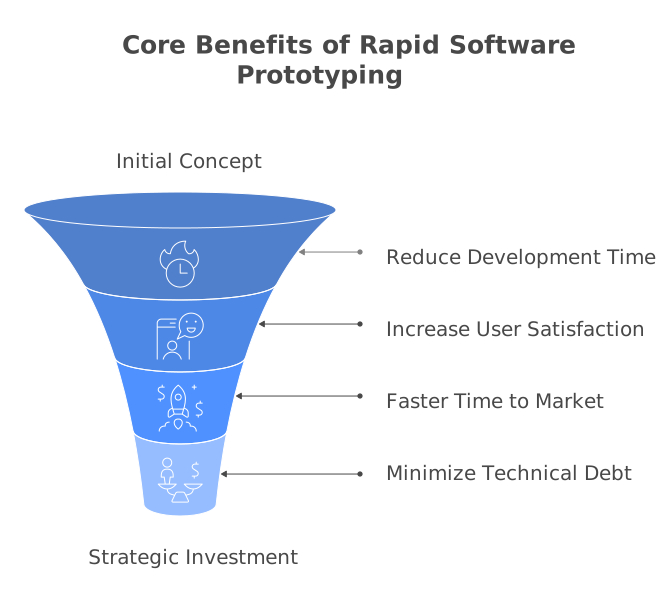
The true power of rapid prototyping in software development lies in the tangible benefits it delivers across the entire product lifecycle.
Together, these benefits make rapid prototyping not just a development practice, but a strategic investment that balances speed, quality, and innovation.
The Rapid Application Development (RAD) methodology is a software development approach designed to deliver high-quality applications quickly through iterative prototyping and continuous user feedback. Unlike traditional models that emphasize lengthy planning, RAD focuses on adaptability and collaboration, making it especially valuable in today’s fast-paced digital landscape.
The RAD process typically follows four key stages:
When comparing RAD vs. Waterfall in software development, the difference is clear. Waterfall follows a rigid, linear path where each phase must be completed before the next begins, often leading to delays and misalignment with user needs. RAD, on the other hand, thrives on iteration and user involvement, ensuring the final product is both faster to build and more aligned with real-world requirements.
Accelerate software delivery without sacrificing quality.
Software prototyping comes in different forms, each serving a unique purpose depending on the project’s goals and stage.
In an iterative prototyping software development cycle, teams often start with low-fidelity versions, refine them based on feedback, and gradually evolve into high-fidelity models before moving to development.
For a startup MVP, low-fidelity mockups are best for quickly validating ideas with potential users or investors. Enterprises, however, often require high-fidelity prototypes for complex platforms, ensuring scalability, compliance, and seamless integration before committing to large-scale builds.
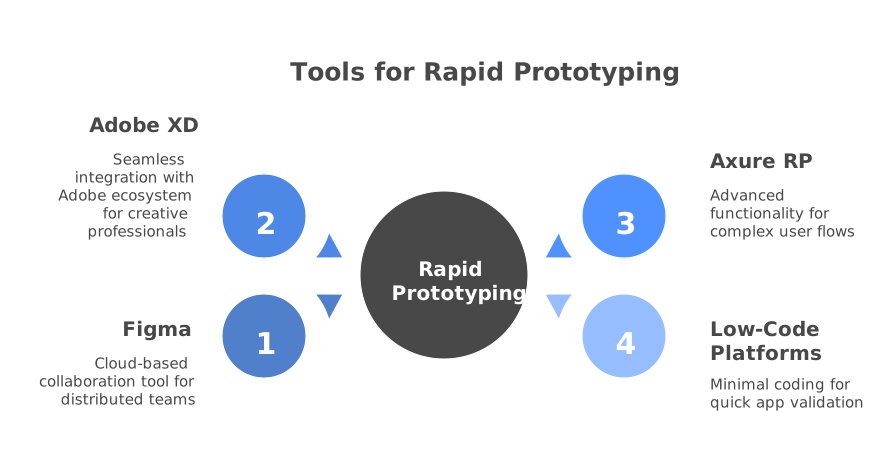
The success of rapid prototyping software often depends on choosing the right tools. Modern platforms allow developers and designers to collaborate, test ideas quickly, and bring prototypes closer to production-ready models.
Together, these tools empower teams to adapt their approach—whether building a lightweight MVP or refining enterprise-scale software—making rapid prototyping for software development faster, more collaborative, and more effective.
Startups often turn to rapid prototyping for software development to validate their Minimum Viable Product (MVP) quickly. By creating functional mockups, they can test core features with real users, attract investors, and refine concepts without burning through limited resources. This lean approach allows them to prototype to market faster, ensuring they launch only what customers truly need.
For enterprises, the value lies in scaling innovation quickly. Large organizations can use rapid prototyping to pilot new features, explore emerging technologies, and roll out updates across complex platforms without disrupting existing systems.
Both startups and enterprises benefit from a user-centered design rapid prototyping approach, where end-users are actively involved in the feedback loop. This ensures that whether it’s an MVP or an enterprise solution, the final product is intuitive, efficient, and aligned with user expectations.
Catch issues early with compliance-ready prototypes.
One of the biggest strengths of rapid prototyping in software development is how it accelerates decision-making and reduces uncertainty.
Ultimately, these advantages make rapid prototyping a strategic choice for businesses aiming to balance speed, cost-efficiency, and user-centered outcomes.
Beyond technical benefits, rapid prototyping in software development delivers measurable business value. By validating ideas early and refining them with real feedback, companies gain a competitive edge—launching products that are not only faster to market but also more aligned with user expectations.
In sectors like healthcare IT, where compliance and usability are equally critical, rapid prototyping enables organizations to test features such as secure patient portals, telemedicine apps, or HIPAA-compliant workflows before full-scale rollout. This ensures that compliance-driven solutions meet both regulatory and user requirements from the start.
Adopting a prototype-to-market faster strategy also allows businesses to outpace competitors, respond to changing market demands, and establish stronger customer loyalty. Whether it’s a startup validating its MVP or an enterprise innovating at scale, rapid prototyping turns concepts into growth opportunities.
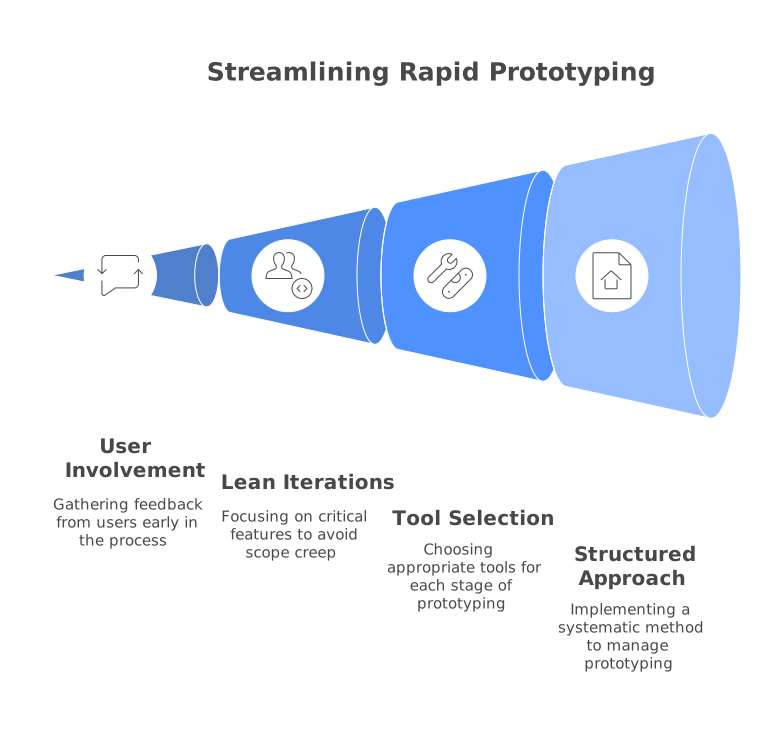
While rapid prototyping software offers speed and flexibility, it also comes with challenges if not managed carefully. Teams often struggle with scope creep, where too many features are added during prototyping, diluting focus and delaying progress. Another common issue is over-engineering prototypes—spending excessive time refining models that were only meant for validation.
To overcome these pitfalls, a few best practices stand out:
At Taction Software, we apply a structured prototyping approach honed through 20+ years in healthcare IT HIPAA-compliant app development. By balancing speed with compliance, usability, and scalability, we help businesses turn prototypes into production-ready solutions without unnecessary risks or delays.
The next wave of rapid prototyping in software development is being shaped by AI and automation. AI-assisted prototyping tools can now generate design suggestions, predict user flows, and even auto-generate code snippets, accelerating the move from idea to functional model. Alongside this, the rise of low-code prototyping platforms is making it easier for non-technical teams to validate concepts without heavy coding.
Rapid prototyping is also becoming tightly integrated into agile and DevOps pipelines, ensuring that continuous feedback and iteration happen seamlessly throughout development. This shift makes prototyping not just an early-stage activity but an ongoing driver of product evolution.
For industries like healthcare IT, where compliance and security are non-negotiable, the future demands compliance-ready prototyping—solutions built with HIPAA and regulatory requirements in mind from the very first iteration. This ensures innovation doesn’t compromise trust, security, or patient safety.
Leverage 20+ years of HIPAA-compliant development expertise.
Rapid prototyping in software development delivers more than just speed—it ensures faster launches, reduced risk, and higher user satisfaction by aligning products with real-world needs early in the process. From startups building MVPs to enterprises scaling complex platforms, the approach transforms ideas into market-ready solutions with confidence.
With over 20+ years of proven expertise in healthcare IT, Taction Software stands out as a trusted partner that combines innovation with compliance. Our structured, user-centered approach helps organizations prototype smarter, scale faster, and stay ahead in competitive markets.
Ready to move from concept to launch without compromising quality or compliance? Book a consultation with our team today.
Rapid prototyping in software development is the process of quickly building interactive models of an application to test design, features, and user flows before full-scale coding begins. Unlike static wireframes, it allows teams to gather feedback early, make improvements faster, and reduce costly rework.
By creating functional mockups that can be tested and refined in short cycles, teams avoid long planning phases. This accelerates decision-making, validates concepts quickly, and shortens the overall time-to-market.
Key benefits include faster stakeholder buy-in, cost savings through early feedback, better alignment with user needs, reduced technical debt, and quicker product launches.
The Rapid Application Development (RAD) methodology is iterative, focusing on prototypes and user feedback at every stage. The Waterfall model, on the other hand, follows a rigid step-by-step process with limited flexibility for changes once development begins.
Popular tools include Figma, Adobe XD, and Axure RP, which offer varying levels of collaboration and interactivity. Low-code platforms like OutSystems and Mendix are also gaining traction for building prototypes with minimal coding effort.
Yes. Startups use rapid prototyping to validate MVPs with minimal investment, while enterprises rely on it to scale innovation, test compliance-driven solutions, and integrate new features without disrupting existing systems.
In healthcare IT, rapid prototyping allows organizations to test HIPAA-compliant features like patient portals, telemedicine apps, and EHR integrations before full deployment. This ensures compliance, usability, and security are built in from the start.