Your email address will not be published. Required fields are marked *
Our expert reaches out shortly after receiving your request and analyzing your requirements.
If needed, we sign an NDA to protect your privacy.
We request additional information to better understand and analyze your project.
We schedule a call to discuss your project, goals. and priorities, and provide preliminary feedback.
If you're satisfied, we finalize the agreement and start your project.
In today’s value-based care environment, healthcare organizations are under pressure to deliver better patient outcomes while reducing costs and improving operational efficiency. One proven way to achieve this balance is through custom healthcare app development. By building applications tailored to specific workflows, patient populations, and compliance needs, providers can enhance care delivery, improve patient engagement, and make clinical decisions faster — all while staying fully HIPAA-compliant.
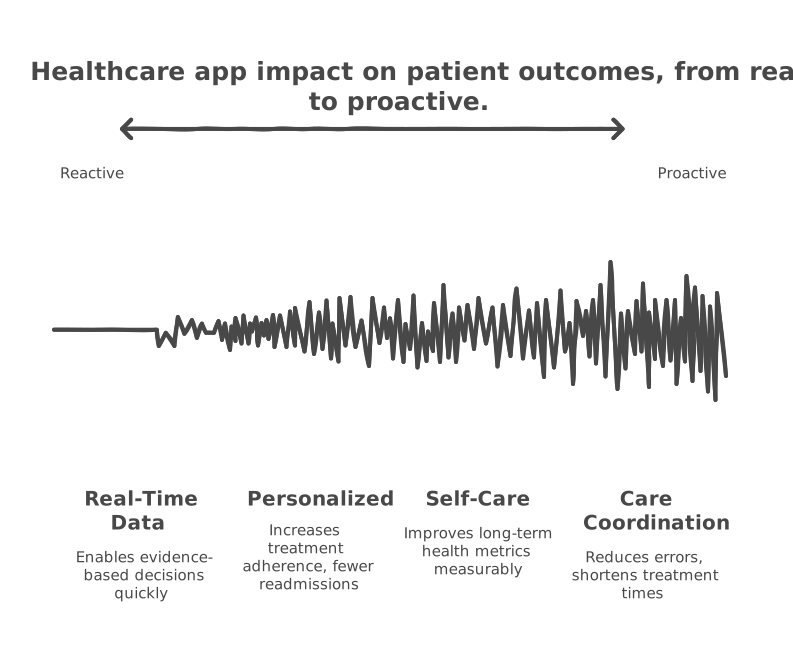
Generic apps often fail to meet the diverse needs of different patient groups. Custom healthcare applications can:
Impact on outcomes: Personalized interactions increase adherence to treatment, resulting in fewer readmissions and better recovery rates.
Also Read: How to Build a HIPAA-Compliant Telemedicine App with Flutter
Custom apps can integrate directly with EHR/EMR systems like Epic, Cerner, or Allscripts, enabling:
Impact on outcomes: Clinicians can make evidence-based decisions quickly, reducing the risk of delays in critical care.
Also Read: Healthcare Mobile App Development in 6 Steps (2025)
Well-designed healthcare apps encourage patients to take an active role in managing their health. Features can include:
Impact on outcomes: Engaged patients are more likely to stick to care plans, leading to measurable improvements in long-term health metrics.
Also Read: How Healthcare Business Intelligence Is Improving Patient Care
In fragmented healthcare systems, communication gaps can harm patient outcomes. Custom healthcare apps solve this by:
Impact on outcomes: Seamless coordination reduces errors, shortens treatment times, and ensures consistent care delivery.
Also Read: How to Develop Medical Software: Step-by-Step Guide
Improving patient outcomes isn’t just about better features — it’s about trust. All custom healthcare apps we develop at Taction Software are built to:
Real-World Success Stories: How Taction Software Transforms Healthcare with Custom Solutions
At Taction Software, our healthcare app development process focuses on:
Also Read: How to Build Secure Healthcare Apps That Pass HIPAA Audits
A: Most projects take 3–6 months, depending on complexity, integrations, and compliance requirements.
A: Yes, we have extensive experience integrating with leading EHR/EMR systems, telehealth platforms, and wearable devices.
A: We implement audit-ready security architecture, encryption, and compliance audits at every stage of development.
A: Adoption rates increase significantly when apps are personalized, intuitive, and aligned with patient needs — exactly what custom development offers.
Custom healthcare app development is more than a technology investment — it’s a patient outcome accelerator. By tailoring solutions to real-world clinical workflows and patient needs, healthcare providers can improve engagement, reduce errors, and deliver care that’s not only efficient but also impactful.
Also Read: Top HIPAA-Compliant App Features Hospitals Need in 2025